

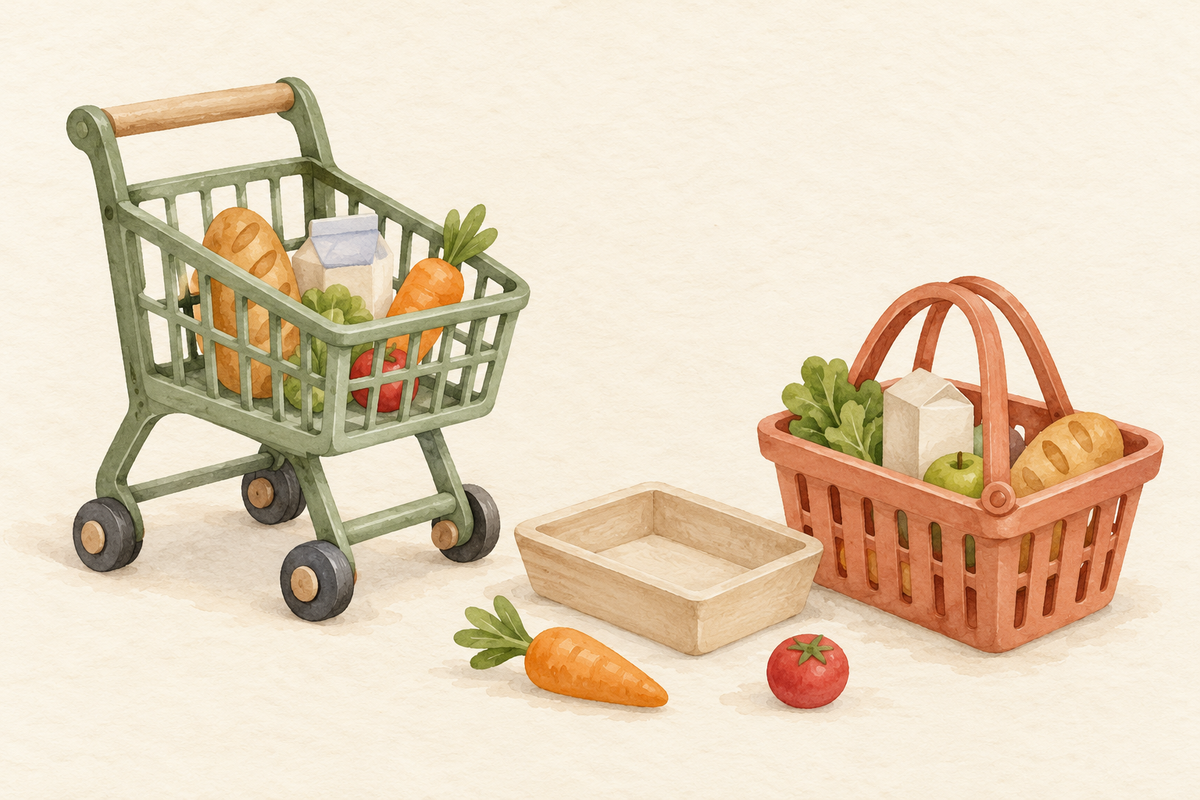
Choosing between a toy shopping trolley and a hand basket starts with one question: what do you want to move when the pretend shopping reaches the checkout? You might want to pass over the whole container, take out individual groceries, or keep a wheeled frame as part of the story.
Use one imagined order and the toy props you plan to use. Compare how that order goes in, how it travels and how it comes out. You can then ask about the exact candidate instead of expecting every trolley or basket to work in the same way. If you are still choosing the whole play area, compare the toy supermarket and play kitchen setups first, then return to this smaller carrying-format choice.
Choose what gets handed over
Picture the end of one pretend shopping trip. Does the shopper give a basket to the shopkeeper, who takes out the groceries and returns it? Or does the shopper leave the trolley beside the checkout and pass over the items one at a time?
Those are different jobs for the container. If handing over the basket is central to the plan, look for a separate carrying container. It might be a hand basket or a basket that is explicitly designed to lift out of a trolley. If the wheeled frame stays with the shopper, the items can be the part that changes hands.
Keep the comparison on that one exchange: what moves, what stays and what needs to be lifted.
Look at the opening and the handles
Choose a pretend item whose shape matters to your plan, such as a tall toy carton. Can you establish how it would go through the candidate's opening and come back out? An overall trolley height or outside basket width does not tell you the dimensions of the space inside.
Look for an internal measurement or a clear description of the opening where that matters. If the only dimensions include the wheels and frame, keep the basket-space question open. Do not invent a capacity from the number of groceries arranged in a styled photograph.
Check the handles as well. If a listing says they fold, find out where they rest when the basket is put down. If a handle remains over the opening, consider whether it crosses the space where you intend to take out a prop. The point is to identify the arrangement, without assuming a handle can move in a way the instructions do not describe.
Check a removable basket in both forms
A candidate with a lift-out basket needs two separate checks: how the complete trolley is used and how the basket is used on its own. Confirm that removal is an intended function for that exact item, then read how the parts separate and reconnect.
Ask which parts remain with the frame and which leave with the basket. Does the intended handover need the basket alone, or do you want the groceries to stay in the trolley throughout the trip? A removable part is useful to your comparison only if it provides an action you actually want.
If the connection is unclear, ask a specific question: “Is this basket intended to lift off and be carried separately, and where is that shown in the instructions?” A basket pictured near a frame is not enough to establish the answer. Keep any replacement-basket compatibility question tied to the exact product too.
Try the same imaginary order two ways
This example is invented; it is not a product description or a report of a family's experience. The pretend order contains a toy loaf, a toy carrot and a toy milk carton. The groceries stay the same while the exchange changes.
Plan one: hand over the container. The shopper collects the order, gives the basket to the shopkeeper and receives it back empty. A separate carrying basket is part of this plan. For each candidate, the useful checks are how its opening and handles are arranged and whether the basket is intended to be used independently.
If a trolley's basket is fixed and the frame stays with the shopper, this particular exchange changes: you would pass out the groceries instead of a separate basket. That can still be a suitable story, but it is a different choice from handing over the container.
Plan two: keep the wheels in the story. The shopper brings the same order in a wheeled trolley and takes the groceries out beside it. Here, the frame's role is part of the plan. Check how the items are reached and removed, and whether you want the basket to stay attached for that exchange.
In the hand-basket version of this invented plan, the container's job is to carry the order; it does not add a wheeled frame. If moving a frame is not part of the story you want, that extra component may be unnecessary. Use the example to name the action you prefer, rather than treating either plan as the better kind of play.
Write the decision in one sentence
Before comparing listings, choose a sentence that describes your plan:
- “We want to hand the loaded basket across, so a separate carrying basket is essential to this exchange; a wheeled frame is optional.”
- “We want to wheel the order up and unload beside the frame; lifting the basket out is optional.”
Then add the one unanswered question that could change your choice: the opening, the handle position or whether the basket is genuinely removable. Keep the seller's answer with the exact item details. A confirmed answer for one candidate does not describe another, even if their pictures look similar.
Use each product's instructions and stated guidance alongside this comparison. You may find that an existing toy prop already provides the exchange you want. Choose a new format for a clear purpose, using the details you can confirm. For a shopping activity after choosing the format, try our picture-list grocery games with the props you already use.