

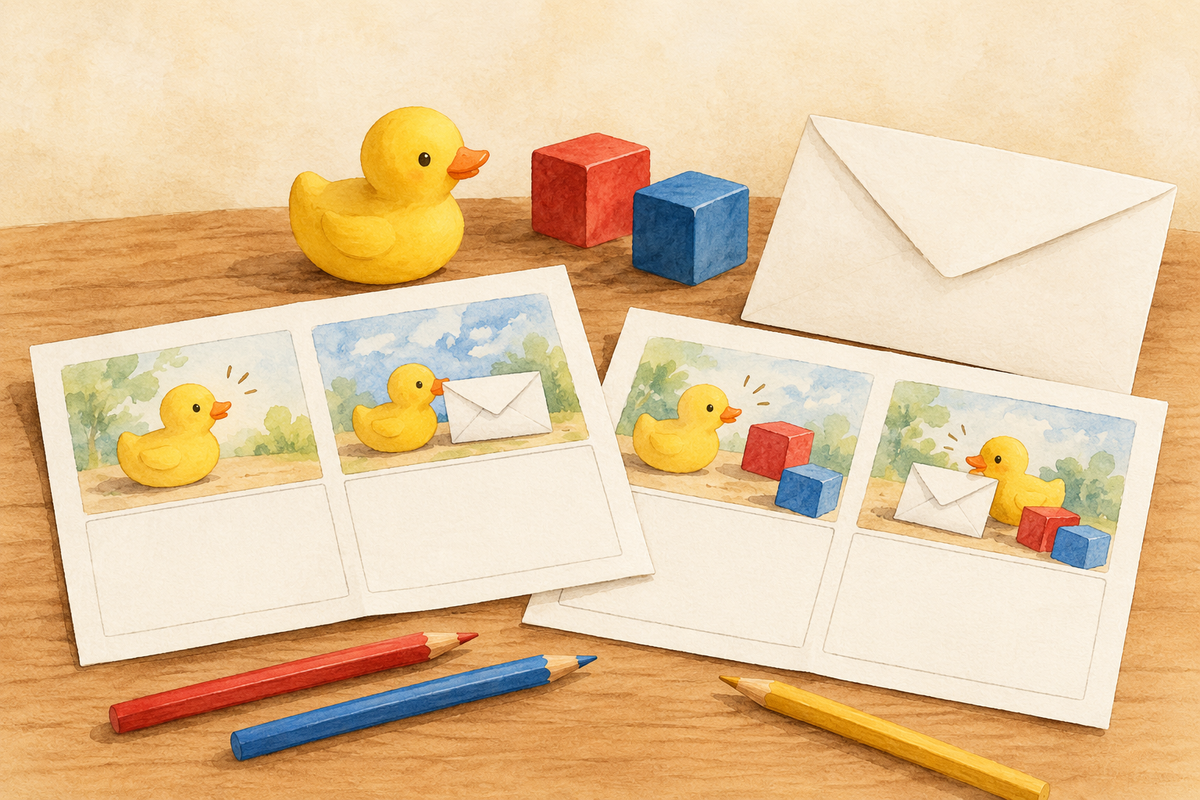
A toy picture story is a small set of pictures with words chosen by your child. It can be two drawings on a folded sheet, several toy-only photos, or an unfinished page that gets another scene later. The aim is to record a story your child wants to tell, rather than supply a plot for them to follow.
You can start with a toy already in use and a pencil. A camera, printer and new props are optional. Here is a practical way to make the pictures and words belong to the same story, including a made-up example you can adapt or ignore.
Find one small happening to record
Begin with something your child has already imagined: a toy waiting for a parcel, a block that has become a house, or a character looking for a letter. Ask whether they would like to make a picture of it. If the answer is no, leave the idea there.
The Australian Government's Learning Potential toy-story activity describes arranging toys in scenes and using photographs to tell their story. You do not need to reproduce its example. Your child can choose the character, what happens and whether there is another picture.
Keep the starting question small: “What is happening here?” usually leaves more room than “Shall we make a story about a duck delivering the post?” If your child offers only one moment, record that moment. There is no need to invent a problem or an ending before you begin.
Choose drawings, toy photos or a mixture
For a paper version, leave space between pictures so you can add words beside or below each one. Separate scraps also work: your child can move them around before deciding which order they prefer. You can draw a toy at their request without adding details they have not chosen.
For a photo version, an adult can photograph each toy scene, framing only the toys and the surface they sit on. Look at one picture together before changing the scene. Ask whether it shows the part your child wanted to record; a close-up of an envelope might suit their idea better than a view of every prop.
A photo can also sit beside a drawing. Your child might photograph a toy duck, then draw the place it imagines going. Keep a space for the words until they decide what they want to say. Printed pictures are optional; a paper story can be made entirely from drawings.
A made-up duck-and-letter story
The following example is invented, rather than a report of a particular child's play. It shows how the same simple props can support different meanings without an adult having to explain them.
- Picture one: a toy duck beside a blank envelope. The chosen caption is “Duck has a letter.”
- Picture two: the duck near a red block. The caption is “The post box is shut.”
- Picture three: the duck beside a blue block. The caption is “Blue box wants letters.”
- Picture four: the envelope beside the blue block. The caption is “Letter has a new home.”
These are four possible pictures, not a required number or a sequence to copy. The story could stop at the closed post box. It could also begin with the blue box, or change into a story in which the letter talks. Let the pictures follow the child's version.
Notice that the blue block is not simply a replacement post box in the captions. It is a character that wants letters. An adult might assume otherwise from the picture alone. Recording the child's words keeps that difference visible.
Add captions without rewriting the story
Ask, “What words would you like beside this picture?” You can write exactly what your child says, leave the space blank, or let them make their own marks. Do not turn every short caption into a longer sentence just to fill the page.
Raising Children Network's family story book activity lets children choose pictures and details, decide on wording, and add drawings for pictures they do not have. The toy example here adapts those choices to an imaginary story, rather than a family record.
If you are unsure what a caption means, ask about that specific part: “Does ‘home’ mean the blue box or somewhere else?” Accept the answer without requiring the picture to look more realistic. If your child changes their mind, write a new caption on a separate strip or move the picture. You do not have to replace the whole page.
Read back what you have, then pause
Read the words in the chosen picture order and ask whether that is the story they wanted. Your child might keep it, swap two scenes, add a missing picture or decide it is finished without a final caption.
You can leave an empty space for another day, but you do not need to promise a second session. One picture and its own words can be the complete record. When your child is ready to stop, leave the story at the point they have chosen.