

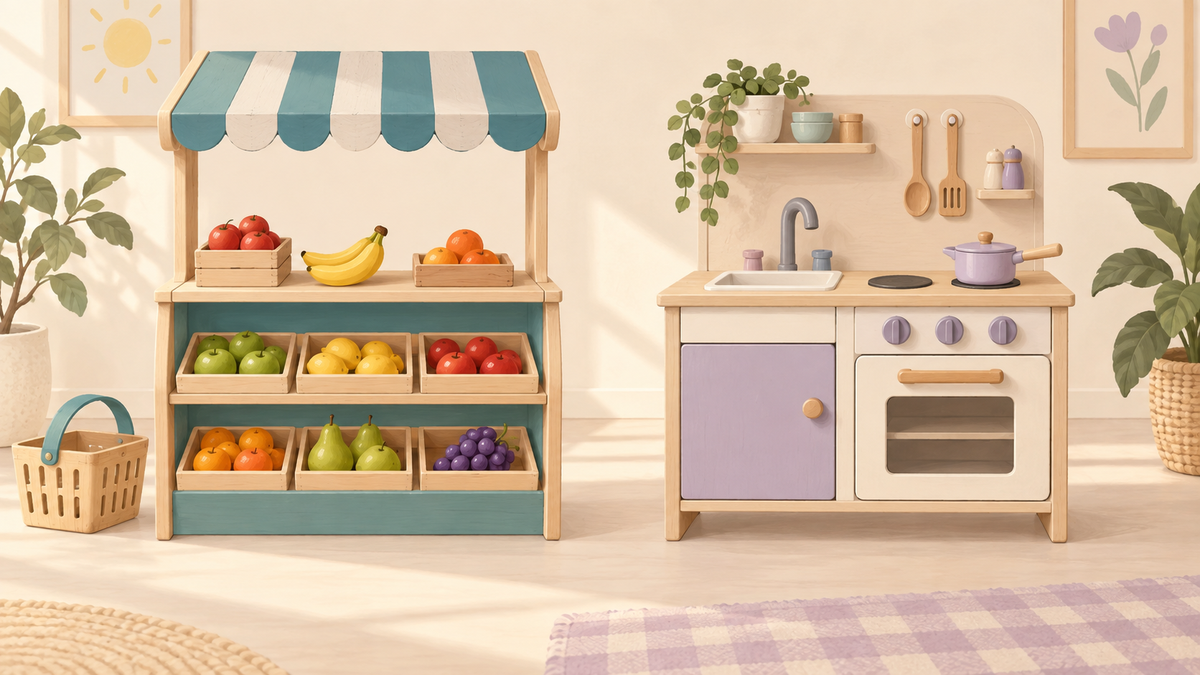
A toy supermarket gives pretend shopping a setting: displaying groceries, choosing items and serving a customer. A play kitchen gives pretend cooking a setting: preparing a meal, arranging food and serving it. Either can become a café, shop or family kitchen in a child's story, so start with the activities your child already enjoys and the space you can offer.
When comparing two actual sets, look beyond the product name. The layout, included pieces, assembly requirements and room needed during play can matter more than whether the box says “supermarket” or “kitchen”.
Which play routine does your child return to?
Watch what happens with the toys you already have. A child who lines up pretend groceries, fills a basket and hands items across a counter may enjoy a shop layout. A child who puts ingredients in a pan, stirs and serves a meal may enjoy a kitchen layout. These are useful clues, not fixed categories: children can switch roles or invent something completely different.
For a low-commitment trial, use existing age-appropriate play food and a clear surface. Try a shop on one day and a pretend cooking area on another. Notice which arrangement your child chooses to revisit. You do not need to buy both large sets to find out.
Compare the layout, not just the floor footprint
A supermarket counter may invite play on two sides, with a shopkeeper behind it and a customer in front. A kitchen may be used mainly from the front, but its doors, cupboards or side features can need additional room. Check the actual design: neither category guarantees a smaller footprint or a particular number of players.
- For a supermarket: identify where groceries will be displayed, where the shopper stands and where any separate trolley or basket will go.
- For a kitchen: check which doors open, where the child stands to reach the play surface and where dishes or food will be placed.
- For either: keep household routes clear and follow the manufacturer's placement and assembly instructions.
Draw a simple plan of your chosen area and write down the assembled width, depth and height of each shortlisted set. Add any separate pieces to the plan. Do not treat the carton dimensions as the assembled size, or assume that fitting the main unit into a corner leaves enough room to use it.
Use a short comparison sheet
For each candidate, write an answer beside these six questions. An unanswered question is a reason to check the listing or ask for clarification before buying.
- What is included? Separate the main unit, pretend food, cookware, till and trolley. A display photograph may show props that are not included.
- What must stay out? List the assembled unit and any accessories that need a permanent parking place.
- What packs away? Decide where loose food and utensils will live after play.
- What needs assembly? Check the instructions, required tools and any fixing requirements for that model.
- What powers the features? If a scanner, light or sound function is included, check battery requirements and whether batteries are supplied.
- Who is it suitable for? Read the exact age guidance, warnings and supervision instructions, including those for separate accessories.
A bigger piece count does not tell you whether the set suits your home. Look at what the pieces actually are and how they will be used. Likewise, a wooden finish, plastic construction or higher price does not by itself establish that a toy is safer, more durable or better for learning.
Think about shared play and noise
If two children will use the set together, picture their positions rather than assuming a larger toy automatically works better. Can one child reach the shelves while another uses the counter? Can a kitchen door open without taking over the other child's space? Does each child have a reachable place to put a prop?
Also consider where the set will sit during everyday family life. If it is near a work area or quiet corner, check whether electronic sounds are optional and how the toy operates without them. Do not assume every till calculates, every scanner makes a noise or every kitchen sink uses water; verify the specific feature description.
If you already own one, try extending the story first
A play kitchen can supply an imaginary shop: arrange a few suitable toy foods on a clear surface and use a basket as the customer's shopping. A supermarket can supply an imaginary meal: carry the groceries to a separate play area and pretend to prepare them. Our picture-list shopping games give you a starting activity using existing props.
If your decision is actually between a full kitchen unit and a portable bundle of cookware, that is a different comparison. See our play kitchen and pretend kitchen set guide for that distinction, then check the details of the models you shortlist.
Choose the setup you can use and put away
Shortlist a supermarket if the shop layout suits the play your child chooses and you have room for both sides of the counter where needed. Shortlist a kitchen if the cooking layout suits their interests and its doors and work area fit your space. If neither fits comfortably, keep using a smaller arrangement and revisit the decision later.
Browse our toy supermarket sets and toy kitchens with your comparison sheet beside you. Check the current individual listing for dimensions, included accessories, age guidance and availability. Choose a specific set on those details rather than expecting every product in a category to offer the same features.