
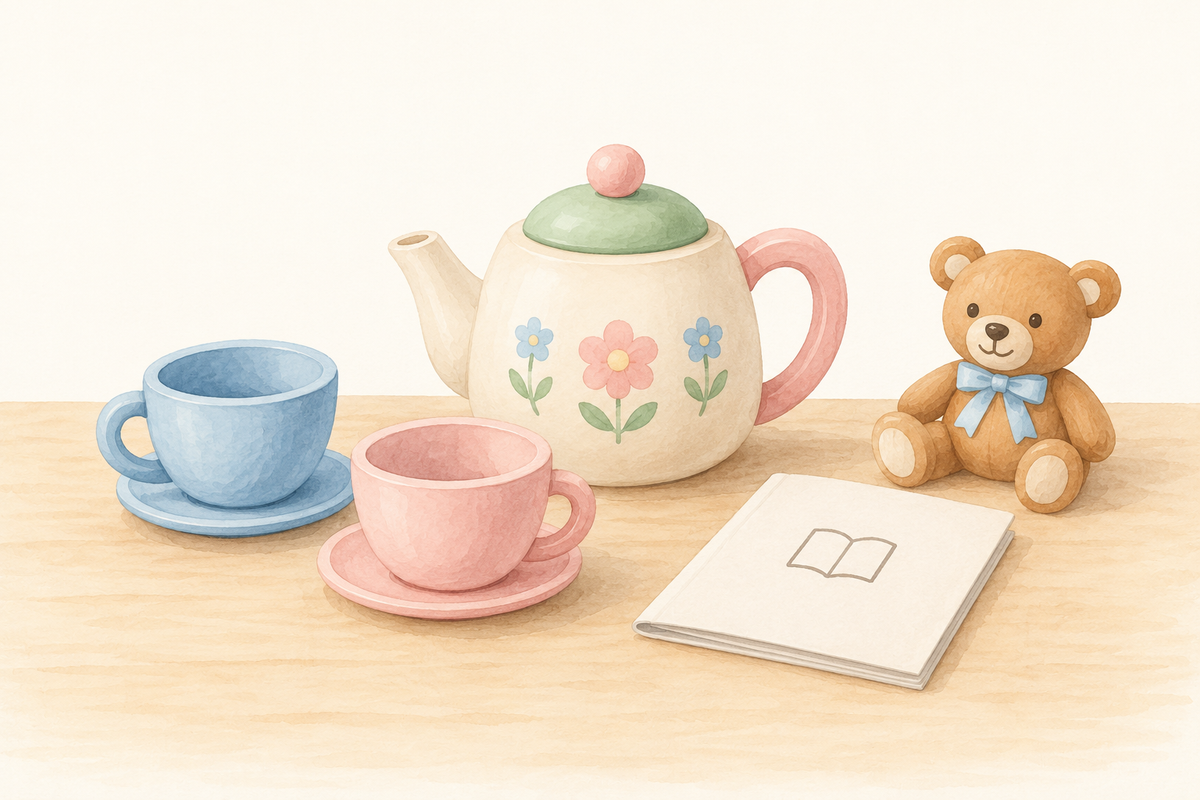
A toy tea set should hold water only when its maker's instructions allow that use for the exact set. A cup-shaped toy, an open-looking spout or the word “pour” in a description does not answer that question. Some tea sets are made for pretend serving with empty cups.
Before filling a toy teapot, separate three questions: may this set be used with water, may it be used for drinking or food, and how should it be cleaned? Keep each answer attached to the exact model. Permission for one use does not establish the others.
Look for the intended use
Start with the product instructions, including any care information and warnings. Look for a clear statement about liquids or water play. A description of the set as “wooden”, “plastic”, “realistic” or “non-toxic” is not a statement that it can hold drinks.
For a concrete example, the Australian maker Make Me Iconic's Iconic Tea Set information says its wooden set must not be used with water or other liquids, and is not intended for food. Its care directions specify wiping with a damp cloth. Those directions concern that particular product.
A different design can have a different purpose. Early Learning Centre's Blue Bath Time Tea Party description explicitly describes filling its teapot with water and pouring into its cups. This is an example of stated water play, rather than permission inferred from a tea-set shape. Neither example establishes how another maker's set should be used.
If you already own a set, find its model name on the box, label or original order. Compare that with the instructions you locate. A similar colour or photograph is not enough to establish that two sets have the same directions.
Keep water, drinking and cleaning separate
Water play: Check whether the exact toy is intended to be filled or used with water. If the instructions prohibit liquids, keep the cups and pot empty during pretend tea. If the intended use is unclear, leave them empty while you check.
Drinking or food: A description of water play does not, by itself, confirm use as drinking cups or serving dishes. If real food or drink is part of your plan, look for the maker's explicit directions for that purpose. An empty-cup tea party does not need that extra use.
Cleaning: Follow the set's own care directions. Wiping with a damp cloth, washing an item and immersing it are different actions. Do not turn a wipe-clean instruction into permission to fill, soak or put a toy in a dishwasher. Check separate directions for electronic parts, if the set has them.
A mixed collection needs separate answers too. Directions for one teapot do not cover a cup borrowed from a different set, a toy cake or a serving tray. Keep each item's instructions rather than treating everything on the tea tray as one washable set.
Read the missing answer in a listing
Imagine an online description that says: “Toy tea set with teapot, cups and a pouring sound.” This is an invented example. It names pieces and a sound, but gives no instruction about adding liquid. The sound might be all the pouring effect the description promises; the text leaves water use unanswered.
Now imagine a second description that adds: “For pretend use only; do not fill with liquids.” That answers the water question for this imaginary set. A larger piece count or a more realistic photograph would not change that instruction.
Do not test a set with water to fill an information gap. Instead, check the maker's current information or ask for the instructions for the item you are considering. If a seller's description and the supplied directions disagree, ask for clarification before using it in the disputed way.
Ask a question that identifies the set
Include the item link and model name when requesting clarification. You could write:
“For [exact set and model], do the manufacturer's instructions permit filling the teapot and cups with water? Please point me to those instructions, including the cleaning directions. I also need to know whether they permit drinking from the cups.”
Leave out the drinking question if you only want water play. Keep the reply with the instructions, so that the answer remains connected to the correct set. If a key question remains unanswered, leave that use out of your plan rather than assuming it is allowed.
Try an empty-cup tea party
Pretend tea can stay entirely imaginary. With a suitable set used according to its instructions, put out the empty cups and invite a toy guest. Ask what imaginary tea it would like, then tilt the empty teapot as though serving. There is no need to add water, real tea, food or loose pretend ingredients.
For example, a toy bear might ask for “cloud tea”. You can say, “One cup of cloud tea coming up,” and place its empty cup beside it. Let your child change the order or decide the bear would rather have imaginary soup. Our ideas for joining pretend play offer more ways to respond without directing the whole story.
If actual pouring is the feature you want to buy, make explicit water-use instructions part of your shortlist alongside the product's age guidance and warnings. If imaginary serving is the plan, compare the pieces you will actually use. In either case, choose from confirmed information about the exact set.