

A pretend café can use the words your family already uses for a bowl, a favourite meal or a welcome. When players use different languages, it helps to keep one thing clear: which object or idea does each word refer to in this game?
Try it with one familiar scene and a family member who knows the words they want to use. The activity below leaves the vocabulary with your family. It offers a way to keep the meaning visible, without supplying translations or asking a child to perform a word list.
Choose the words people already use
Begin with a scene your child has chosen, such as serving an imaginary meal to a toy guest. Use the suitable toys already involved and follow their instructions. Ask the adults taking part which familiar words they would naturally use for that scene. One word can be enough.
For example, a relative might use the word they normally say for soup at home. Use their own wording rather than inventing a translation from a product label or an unfamiliar online phrase. If nobody present knows the word you wanted, keep using the words you know and ask that relative another time.
Raising Children Network's suggestions for multilingual and bilingual families include telling stories and playing games in a heritage language. Here, that becomes a small optional part of an existing pretend scene. There is no set number of words to introduce or repeat.
Separate the object name from the story name
A toy bowl, the imaginary soup inside it and the invented name of the dish are three different things. Point to the one you mean when a word is unfamiliar. This is useful when one player thinks a new word names the bowl, while another is using it for the pretend soup.
Keep your child's invented names too. If the dish is called “moon soup”, that can remain its name in the story even while a family member uses a familiar word for soup. You do not need to turn “moon soup” into a translation exercise or decide that every player must use the same label.
If someone wants a reminder, draw one simple picture beside the word: the bowl, the imaginary meal or the toy character. Ask the person who supplied the word to check that the reminder means what they intended. A drawing can point to the meaning even when another player cannot read the writing.
Try a made-up café scene
This example is invented. It does not describe a particular family or provide words in a named language.
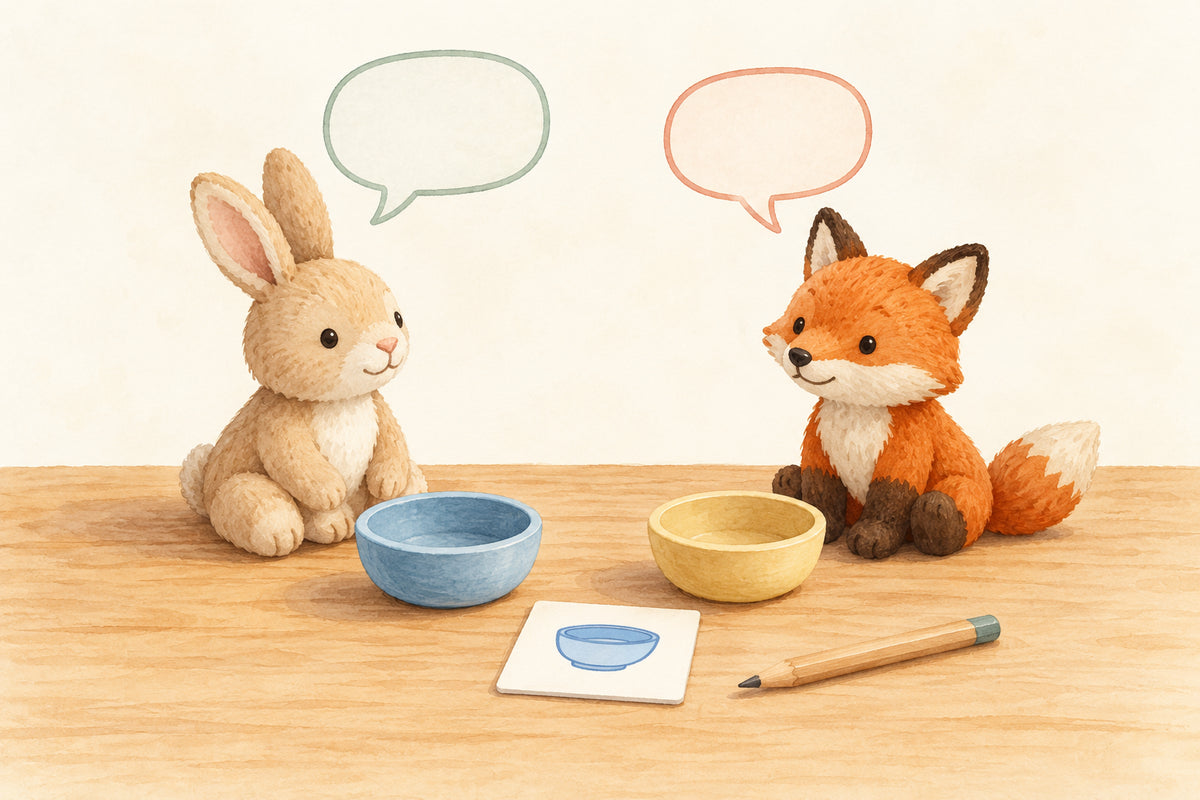
Set the scene: Rabbit is a customer and Fox is serving an imaginary meal. There is an empty toy bowl on the café counter. The child calls the dish “moon soup”. Nan would like to use the word she normally uses for soup.
Agree what the word means here: Nan says her familiar word and points to the imaginary meal. Another adult checks, “That is the soup, rather than the bowl?” Nan confirms or explains the distinction in words the adults understand. The bowl stays empty throughout the game.
Let the order continue: Rabbit can ask for moon soup, point to the bowl or use Nan's familiar word if the player chooses. Fox can answer in the language the player is comfortable using. The order can carry on without anyone repeating a phrase on request.
Notice a change: If the child decides the bowl now contains an imaginary pudding, ask which meaning the word reminder should show. Keep Nan's word connected to its agreed meaning, and change the pretend menu separately. A new story choice does not require the family word to mean something different.
Include a player who does not know every word
A player can ask, “Which thing do you mean?” and point to the possible props. The person who knows the word can show or explain it. Give an adult their own way to check meaning, rather than making the child responsible for translating every exchange.
Use a language you can speak comfortably for your own part. Raising Children Network's reading and storytelling guidance says families can tell stories in the language they feel most comfortable speaking. The café example adapts that choice to an imaginary scene; it is not a language-learning programme.
If you are joining the game, take the part offered to you. Our simple replies for joining pretend play cover that broader conversation. For this activity, the extra job is only to make an unfamiliar word's meaning available to the people who need it.
Keep one small reminder if you want it
A reminder is optional. You can say the word aloud again at another session, or keep a short note with the play materials. If you write one, these four lines are enough:
- Picture or prop: draw the thing the word refers to.
- Family word: ask a person who uses it to write or check it, in their preferred script.
- Meaning in this game: note whether it names the object, imaginary food or character.
- Who can help: name the family member who can explain it next time.
You can leave the writing out. There is no need to invent a spelling from sound, add a pronunciation guide or collect a card for every toy. Keep just the reminder the players actually want to use. Next time, begin with their current story and choose whether that word belongs in it.