

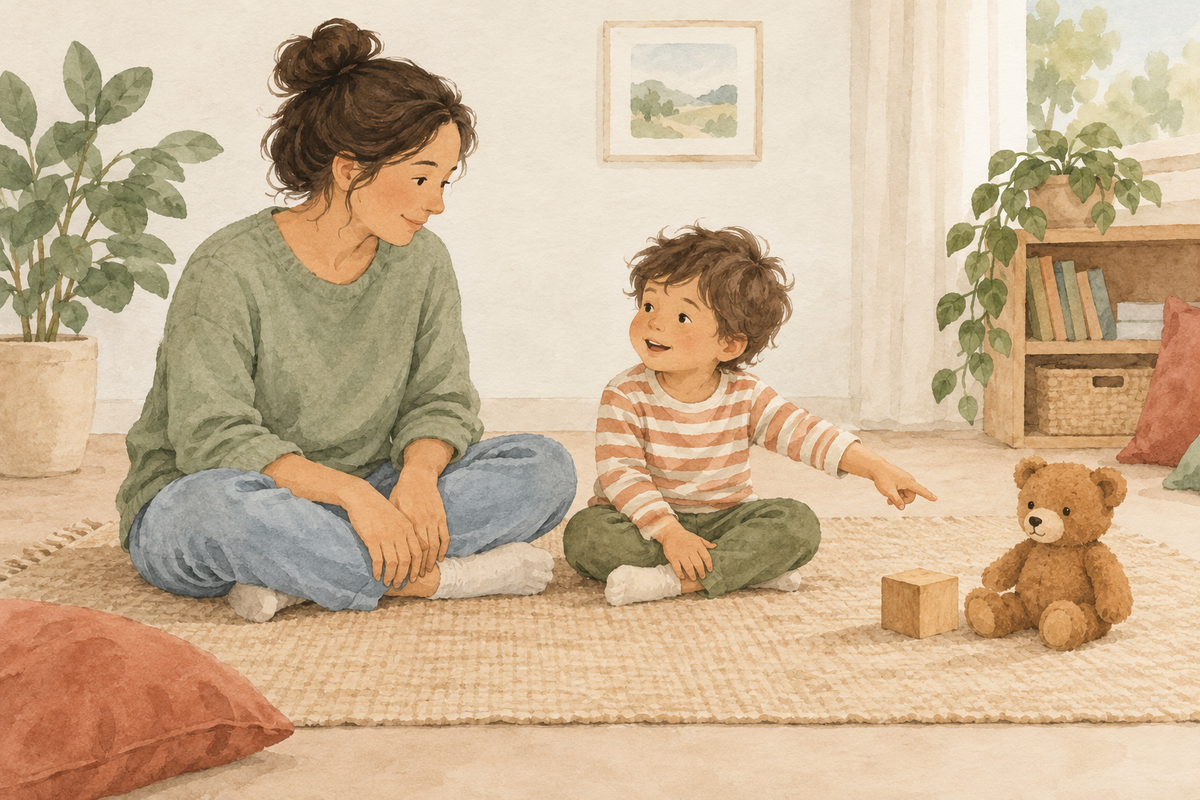
Your child announces that Teddy is driving a bus. You are invited to be a passenger, but you are not sure what to say next. You can join with a small reply that fits the idea already in front of you, then leave space for the next part of the story.
The examples below are invented scenes and optional words to try. They are not a script to finish or a test of how a child plays. Choose a reply that feels natural, change the wording, or simply watch for a while.
Ask for a place in the story
Before moving a prop or announcing a new character, ask, “Can I join?” If the answer is yes, try “Who shall I be?” You might be given a customer, passenger, neighbour or audience role. Start with that role and one small action rather than planning the whole scene.
Raising Children Network's child-led play guide suggests asking to join, going along with the activity and giving your child time to respond to comments or questions.
If no role is offered, you can say, “I'll watch this part.” Joining is an invitation, not a requirement to add dialogue. You do not need to turn watching into a stream of questions.
Choose one reply, then leave a pause
Try a short observation about the pretend scene, or a question whose answer is still open. “The bus has arrived” leaves the next event undecided. “Where are we going?” asks for one detail. Use either, then pause rather than adding a route, a timetable and several passengers at once.
A researcher's article republished by the Australian Institute of Family Studies suggests responding during pretend play with observations or open-ended comments instead of instructions, and asking what role your child would like you to take.
Your reply can be an action within the role: wave as a passenger or sit ready as an audience member. A spoken answer is not something you need to demand before the scene can continue.
Four small scenes and possible replies
Use these as examples of leaving the next decision open. They are imaginary situations, not accounts of families we have observed.
1. You are given a role. Your child says, “You're the passenger. Teddy is the driver.” Try, “Hello, driver. May I come aboard?” Then follow the answer. You do not need to choose where the bus goes or explain how a real bus works. If your child points to a place for you, take that as the next part of this pretend scene.
2. A prop has a new meaning. A block becomes a microphone and your child announces a show. Try, “I'm ready to listen.” That accepts the meaning offered without deciding what the performance will be. Wait for a song, a speech, a gesture or another idea. If the block becomes a telephone instead, you can change your role too: “Hello, who is calling?”
3. The story changes mid-scene. The bus is suddenly a boat. Try, “A boat now. I'll be the passenger on the boat.” There is no need to settle the earlier bus story first. If you are unsure what is happening, ask one small question: “Where shall I sit?” You can carry on with the new idea without adding a storm, a rescue or a destination of your own.
4. You are told exactly what to say. Your child asks you to announce, “The moon shop is open.” You can use those words in your normal voice. You do not need a special accent or a long performance. If the next instruction is unclear, try, “What does my character say next?” Keep the reply within the pretend role rather than making a lesson from the unusual shop.
If your idea is not used
You suggest that the boat has a picnic, but the story continues without it. Leave the picnic suggestion there. You can return to the role you were given or say, “I'll wait to see what happens next.” One offered idea does not need to become the plan.
If your child says, “No, that's not what happens,” try, “Okay. Tell me what happens in this story.” You can also make a simpler reply: “Okay, you're choosing this part.” These words are options, not a promise that every exchange will go smoothly. If you are both finished with the scene, you can leave it unfinished.
Step back or finish your part
When you want to be quieter, say, “I'm going to watch for a little while.” If you need to stop joining, be clear about your own part: “I'm finishing my passenger part now.” You can offer a short pretend goodbye, but you do not have to invent an ending for everyone else.
At a later session, begin with the idea that is there then. There is no need to recreate yesterday's bus, boat or moon shop unless your child brings it back. Choose one reply, leave a pause and see whether you are invited into the next part.