

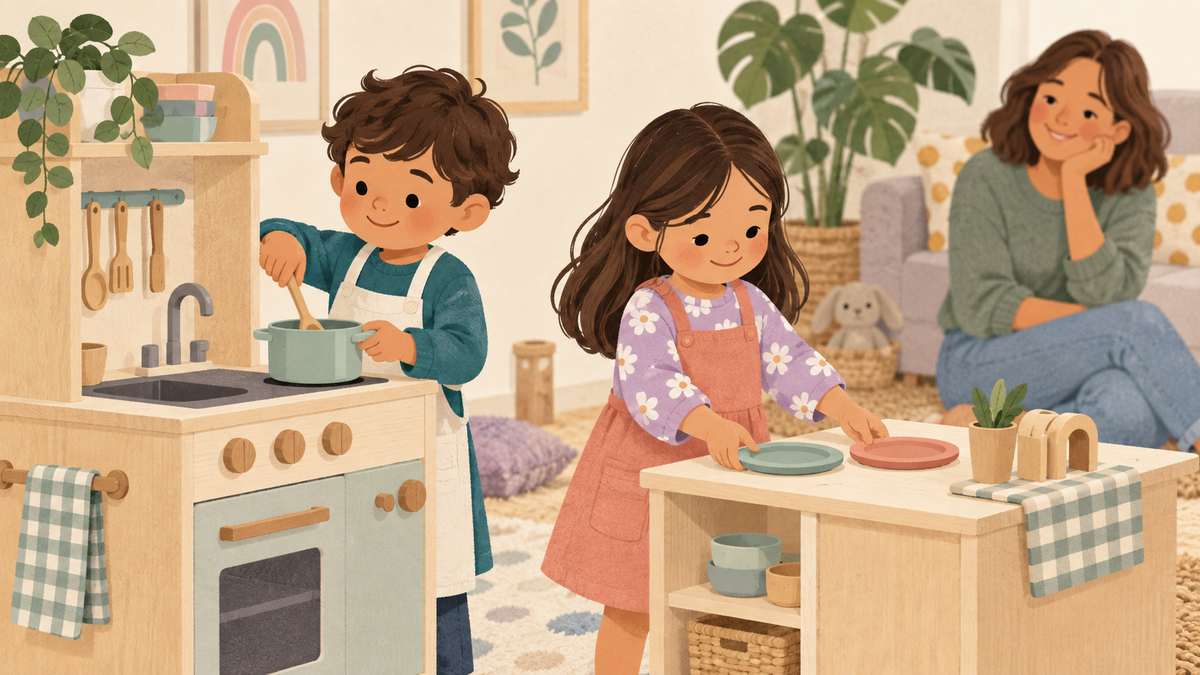
Two children, one toy oven and one favourite saucepan: a shared play kitchen can need a little planning. Start with a job for each child, decide how a turn ends, and leave room for children to play alongside each other when a shared story is not working.
The ideas below are suggestions for pretend play, using the kitchen and suitable accessories you already have. You can try one short scene and stop there. There is no need to buy a second kitchen or keep a game going after everyone has lost interest.
Start with two jobs that can happen at once
Instead of assigning one child to cook while the other waits, give both something to do. Ask each child which job they would like, then choose a small pretend meal together. Keep the first scene simple enough to explain in one sentence: “We are making lunch for two teddy bears.”
- Soup maker and table setter: one child stirs an empty toy pot while the other puts out toy bowls.
- Sandwich maker and picnic organiser: one assembles suitable pretend food while the other arranges plates for the picnic.
- Breakfast cook and menu designer: one prepares an imaginary breakfast while the other draws what is being served.
These are starting prompts, not fixed roles. A child can change the story, decline a job or suggest another one. Avoid making the older sibling the permanent organiser and the younger sibling the permanent assistant.
Toy Libraries Australia’s guidance on sibling play suggests clear roles and adapting activities to different interests and abilities. It also recognises that enjoyable play together can simply mean children sharing a space, rather than participating equally in one game.
Make the handover part of the story
Choose a visible finishing point before a turn begins. For example, the saucepan changes hands when the pretend soup has been served into two bowls. That gives the children something concrete to follow without requiring them to keep track of a long sequence.
Try this three-part routine:
- Name the current job: “You are stirring this soup.”
- Name the handover: “After we serve the two bowls, the saucepan goes to your sister.”
- Name the next job: “Then you can choose what the teddy bears have for dessert.”
Check that both children understand and accept the plan. If finishing a pretend meal keeps becoming an endless task, simplify it to one bowl or agree on a different marker together. A timer can be an option if both children find it useful; it does not have to be part of every game.
When both children want the same piece
Pause the story and describe the problem calmly. You might say, “You both want the blue pot. What could we use for the other meal?” Offer a choice between waiting for an agreed turn and using another suitable piece. If the game is becoming upsetting, take a break rather than forcing the scene to continue.
Raising Children Network’s sharing guide explains that consistent sharing is an unrealistic expectation for toddlers. It recommends adult guidance, practice and help finding a fair solution. A difficult afternoon does not mean the toy or the children have failed.
For your next session, notice which item caused the disagreement. If it was the single spoon, two suitable spoons from your existing play set might be more useful than putting out every accessory. Check each item’s age guidance and instructions for the children using it; a piece suitable for one sibling may not suit another.
Try a side-by-side version
Some days, both children may want to cook their own meal. Give each a small set of suitable props and a separate place to arrange them. One could make pretend breakfast beside the kitchen while the other works at the toy hob. They can show each other their meals without having to agree on a shared menu.
Do not add extra furniture unless the room has space for it. A clear existing play surface may be enough, provided it suits the children and the activity. Keep access to doors and walking routes clear, and follow the kitchen’s assembly and use instructions.
Stay nearby to help with disagreements. Raising Children Network’s sibling guidance suggests having enough toys available so children are not always waiting for turns, and keeping younger children’s play close to an adult.
A quick plan you can reuse
Before the next session, fill in these five lines with the children. Say the answers aloud or draw simple pictures; reading and writing are not required.
- Today’s pretend meal: __________
- First job for each person: __________
- The piece we will take turns with: __________
- The point when we swap: __________
- Our separate-play option: __________
At pack-away time, ask what they would like to keep the same next time. You might discover that serving the teddy bears was more interesting than using the oven, or that separate bowls were all the setup needed.
Do you need more accessories?
Try the routine with your current set first. If a missing piece repeatedly stops the play, browse play kitchen accessories and check the individual item’s contents, dimensions and age guidance before choosing. A large set is not automatically the best fit for a small shared area.
If you are still deciding between a shopping counter and a cooking setup, our toy supermarket and play kitchen comparison covers the layout questions. For children who want a shop story next time, try the separate picture-list shopping games.