

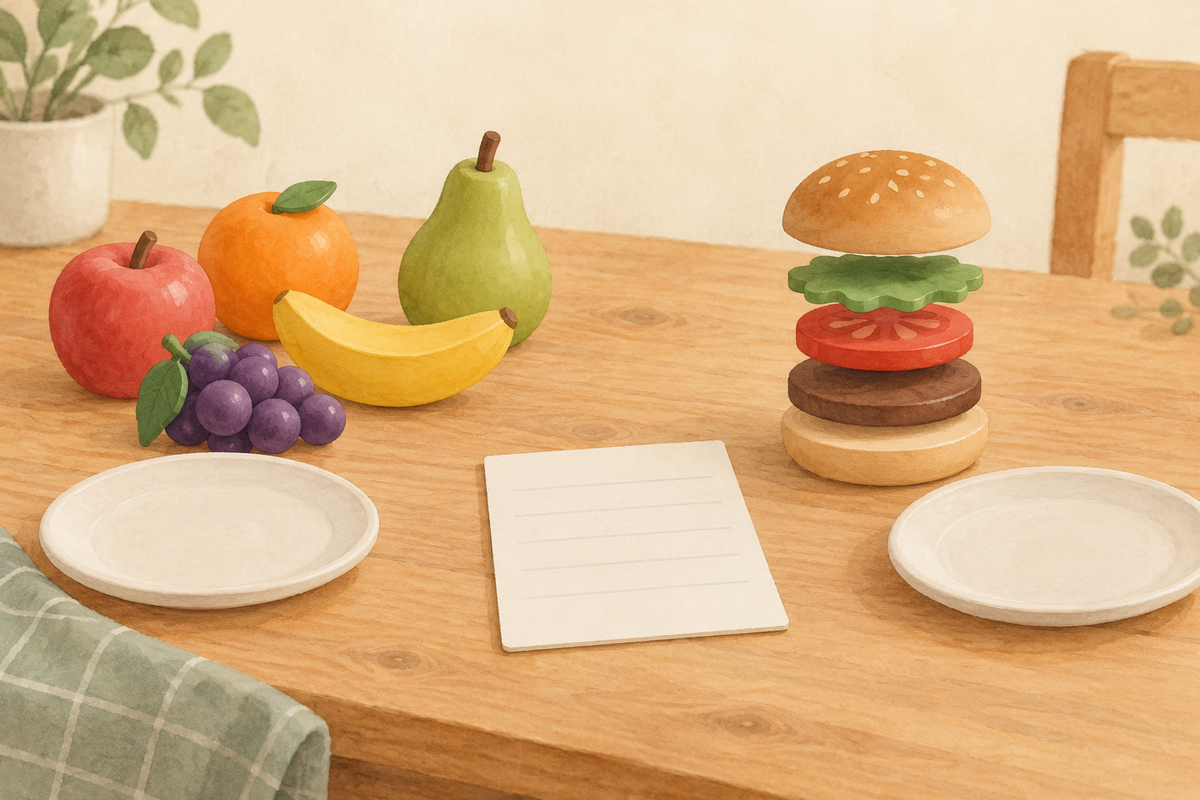
Two pretend food sets both say “20 pieces”. One might contain several whole food props, while another uses separate layers to make a smaller number of pretend burgers. The headline number alone cannot tell you what will be on the plate when those pieces are arranged.
Before comparing totals, look at what each set contains and how you want to use it. This guide uses two invented sets to show a practical way to read the count. They are examples for comparison, not descriptions of products for sale.
Keep the total and the food count separate
Start by copying the advertised total exactly as written. Then make a second note of the food props and a third note of supporting pieces, such as toy dishes, utensils or a container, where the contents list includes them. Keep these notes separate until you know how the seller has counted the set.
A whole toy apple and the two parts of a toy apple are different descriptions. If the listing says that an apple separates into two parts, record both facts: one apple-shaped food prop when joined, two components when apart. Do not assume that every food in a set separates, or that every separate part contributes to the advertised total in the same way.
Your own assembled-food count is simply a way to compare the contents. It is not a replacement for the manufacturer's stated piece count. If you cannot reconcile the two, leave a question beside the listing rather than making the numbers fit.
Try the same-total comparison
The following sets are entirely imaginary. Each has a total of 20 loose pieces, but their contents support different pretend arrangements.
Example A: a mixed food set. It contains six single-piece food props, four food props that each separate into two parts, two plates, two spoons, one board and one basket. The count is six whole pieces + eight food components + six supporting pieces = 20. When each pair is joined, there are ten assembled food props, alongside the six supporting pieces.
Example B: a burger set. It contains four pretend burgers. Each burger has a bun top, bun bottom, filling and topping: four components. The set also has two plates, one tray and one toy scoop. The count is 16 burger components + four supporting pieces = 20. Counting each completed burger as one pretend serving gives four burgers; the components remain separate pieces when unstacked.
The arithmetic does not make either set the better choice. Example A offers ten assembled food props in this particular invented arrangement. Example B offers pieces for making and remaking four burgers. If your aim is a pretend burger counter, the second arrangement might match the idea more closely despite its smaller assembled-food count.
Check variety as well as quantity
A count of food props is different again from the number of food types. Four identical toy apples are four food props but one type of food. Four different fillings might be separate pieces within a single pretend sandwich. Decide which distinction matters for the set you are considering.
For example, someone wanting to lay out a mixed pretend fruit plate would check the named fruit and quantities. Someone wanting to repeat the same pretend café order would check whether the required pieces appear more than once. Neither needs to treat duplicates as a problem automatically.
Read the quantities beside the names rather than estimating them from a group photograph. Match the important pictured objects to the written contents. If a bowl, tray or background prop is not identified, ask whether it is included. An unclear photograph is a reason to check, not proof of an extra item.
Write a contents note you can actually compare
Use one short note per listing. Include the exact set name or link so that the answers stay attached to the correct product. Five lines are enough:
- Advertised total: the number and wording used by the seller.
- Food props: names, quantities and any repeated items that matter to your plan.
- Separate components: which food props come apart, and the listed number of parts.
- Supporting pieces: the dishes, utensils, trays or containers explicitly included.
- Still unclear: the exact item or counting question you need answered.
For Example A, an important check would be whether the stated total includes the plates and basket. For Example B, it would be whether “four burgers” means four completed arrangements with all 16 components. A specific question is easier to compare with the answer than “Does this have lots of food?”
Keep the description and any clarification together. The ACCC's buying online guidance advises keeping documents including emails and item descriptions. Here, that also gives you a record of which contents you used for your comparison.
Choose the contents that fit your plan
Picture one pretend arrangement you would like to make: a fruit plate, a lunch tray or a burger order. Which listed pieces would it use? Which pieces do you already have? A set need not have the largest total to provide the particular food props you are looking for.
Keep the product's age guidance and instructions separate from this counting exercise; a clear total does not establish suitability. Check each individual listing rather than carrying the contents of one set across to another. Choose from the confirmed contents, and keep any unresolved detail as a question before ordering.