

A pretend shop can offer a choice beyond collecting everything on a list. With a small imaginary spending limit, the shopper decides what goes in the basket and what stays at the shop.
This round uses invented prices for three pretend foods. They are game numbers, not real prices or a family budget. Use props you already own or draw the items on paper. No working till, calculator or real payment is needed.
Agree on the prices before the round
Choose a few items together. Give each one a pretend price, then agree how much the shopper can spend in this round. Keep the numbers visible beside the items so neither player has to remember them. An adult can write or say the amounts.
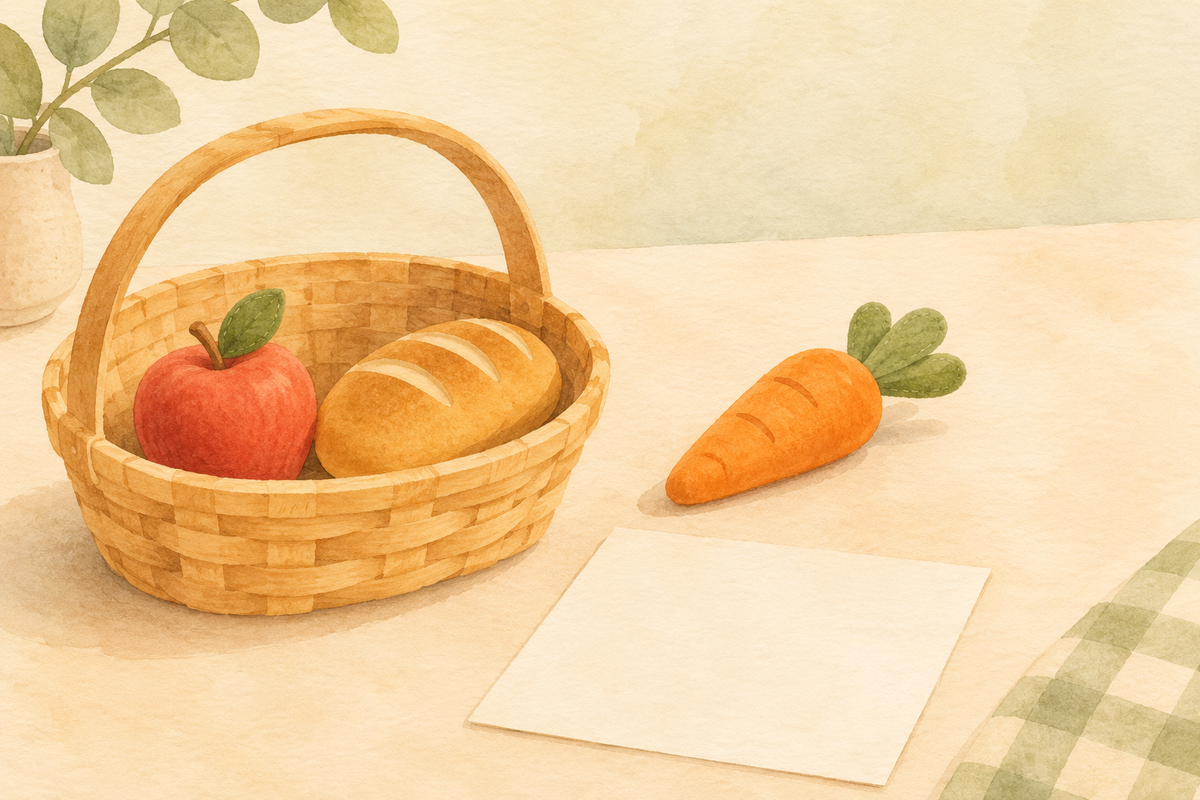
For our imaginary shop, an apple costs 2, a loaf of bread costs 3 and a carrot costs 2. The shopper has a limit of 5. Call these pretend units rather than presenting them as the price of actual groceries. Use the same prices throughout this round.
Raising Children Network’s play-shop activity suggests discussing prices and acting out buying and selling, including examples with a budget. The three-item round below is our own example.
Let the shopper know the choice in advance: “We can choose things up to 5. We do not have to buy everything.” If your child wants a different limit, agree on it before starting and work out the example again.
Try a basket that goes over the limit
Put all three items in the pretend basket. Read their prices together: 2 for the apple, 3 for the bread and 2 for the carrot. The total is 7, which is more than the agreed 5. Pause here rather than secretly changing a price to make the basket work.
You could say, “This basket comes to 7. Our limit is 5. What would you like to leave at the shop?” The shopper can point, move an item or tell you. They do not have to explain their preference before choosing.
Remove the chosen item and total only what remains. Leaving the carrot gives apple and bread for 5. Leaving the apple gives bread and carrot for 5. Leaving the bread gives apple and carrot for 4. Each is within the same limit; there is no single required basket.
If counting interrupts the story, handle the totals yourself and let your child choose. Say what you are adding or mark the amounts on paper; they can join in wherever they want.
Compare two baskets without picking a winner
Look at two possible choices side by side. Basket A is the bread and apple: 3 plus 2 makes 5. Basket B is the apple and carrot: 2 plus 2 makes 4, leaving 1 of the pretend limit unused. Put the remaining shop item beside each drawing so the choice is visible.
Ask what each basket is for in the story. One shopper might want bread for an imaginary café sandwich. Another might choose the apple and carrot for a toy guest. Accept the pretend purpose they choose; the game does not need rules about real meals.
Basket B leaves 1 unused; there is no need to add something just to spend it. Basket A uses all 5. Neither basket is the better meal or the required choice: they tell different stories within the same pretend limit.
Swap one item and count the new basket
Now try a change to Basket A. Start with the bread and apple, total 5. The shopper decides to put the bread back and take the carrot instead. Return the bread to the shop before counting the new selection.
The new basket contains only the apple and carrot. Its total is 4, leaving 1. The item left behind is no longer part of the bill. You can cross out the old basket drawing and make a new one, or move the props so only the current choice sits at checkout.
Suppose the shopper then adds the bread again. All three items make 7, so that basket is over 5 again. Offer the same choice about what to leave. A fresh look at the current basket is enough.
Keep the prices fixed while comparing these baskets. If the shopkeeper wants to hold a sale, finish the round first. Then agree on the new prices and limit for another game. That separates a changed basket from a changed price.
Make the round smaller or leave the rule behind
For a shorter version, use two items priced 1 each and a limit of 1. The shopper chooses one. You can handle the number talk, and pointing is enough for the choice. There is no need to use the three-item example or reach a particular difficulty.
Offer to swap shopkeeper and shopper, or close the shop after one trip. If your child would rather take every item and make a pretend feast, set aside the limit and follow that different game. The agreed rule is a play idea, not a test of responsible behaviour.
For matching items to pictures and choosing an imaginary meal, our pretend grocery shopping games cover a different starting point. If you are separately comparing a toy till, the cash register feature-label guide explains how to check its stated functions. This activity assumes no response from a scanner, drawer or display.
To return to the budget game another day, keep the three prices and the limit together on your sheet. The useful prompt is simple: “What will you take this time, and what will you leave?” Let the next basket be a fresh choice.