

A second-hand play kitchen can look promising in a listing, but the useful questions start before collection: which model is it, what comes with it, and what will you need to do before it is ready for your child? This guide helps you organise those answers without relying on a seller's description of “good condition”.
Use it for a kitchen offered by a private seller, a second-hand shop or another family. It is a buying and collection planner, not a safety certification or a repair guide.
Start with the model, not the photograph
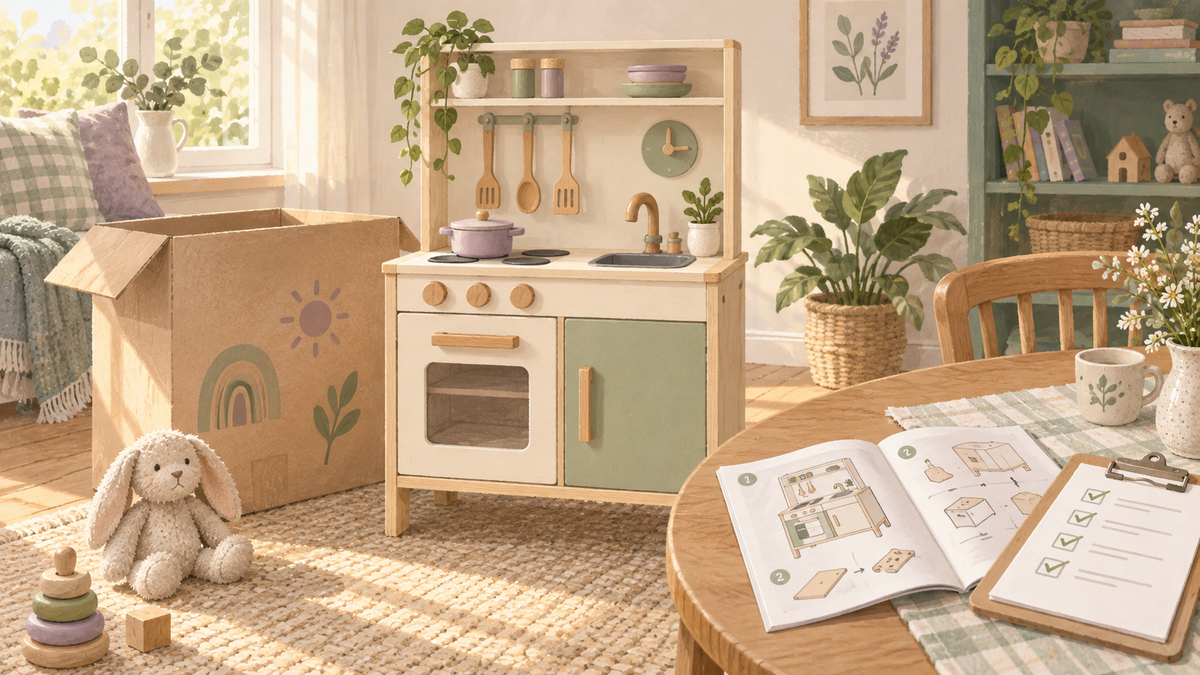
Ask for the brand and model name, a clear photograph of its identification label, and the instruction booklet. Save these together with the listing so you can match the actual kitchen to the correct information. Two kitchens in the same colour can have different fittings or accessories.
The ACCC's second-hand buying guidance recommends reviewing photographs and descriptions, checking for recalls and obtaining the original instructions. It also distinguishes business purchases from private sales: most consumer guarantees do not apply to a private sale between individuals. Read the ACCC guidance for the detail relevant to your purchase, and keep the listing and proof of purchase.
Put unanswered questions in a separate note. A blank beside “model” is a reason to ask another question, rather than fill it in from a similar-looking online photograph.
Separate the kitchen from the accessory bundle
Make two lists: the kitchen itself and the loose extras. Ask the seller to photograph everything included together. A picture styled with pots, food and an apron does not necessarily mean those items are part of the sale.
For your own comparison, mark each item as included, excluded or unconfirmed. For example:
- Kitchen unit and removable sink: included or unconfirmed?
- Instruction booklet: paper copy or an exact-model download?
- Loose pretend food and utensils: which pieces are included?
- Extra storage baskets shown beside the kitchen: included or used only for the photograph?
This inventory helps avoid a disappointing pickup. It does not establish that every item is suitable for the same child.
Check condition and age guidance before agreeing
The ACCC's kids' toys guide advises checking age labels, sturdy construction and the condition of second-hand toys. It says used toys should not be recalled, should meet applicable mandatory standards, should include instructions and should have parts in good working order.
Look for broken pieces, sharp edges, splinters and parts coming loose. Check each accessory separately. Light-up or sound-making extras may contain button batteries; the ACCC advises checking for secure battery compartments that require a screw or tool to open. Do not assume a bundle is suitable because the main kitchen looks substantial.
If you cannot resolve a condition or safety concern, leave the purchase pending or choose another item. An attractive price does not answer a missing safety question, and this checklist cannot verify compliance from photographs.
Work out the collection plan and total cost
Ask for the assembled width, depth and height, then compare them with the space at home and the vehicle opening. Include the route from the pickup point to the car: stairs, a lift or a narrow doorway can change the practical plan. Agree in advance whether the kitchen will be assembled when you arrive.
Allow for more than the advertised price. Your comparison note can include the purchase amount, collection costs and any confirmed replacement parts. Keep an unknown cost marked “unknown”; do not count on finding a matching part later.
Here is a fictional budgeting example: a $40 listing plus $25 transport totals $65 before any other confirmed costs. If a needed part has no verified price or availability, the total is still incomplete. The figures are an example, not a price estimate for second-hand kitchens.
Send one clear message before pickup
Copy and adapt this message to save a series of back-and-forth conversations:
Hello, I am interested in the play kitchen. Could you confirm the brand/model, assembled dimensions and exactly what is included? Please send a photo of the label, the full kitchen and the loose accessories. Is the instruction booklet available? Please also describe any missing parts, damage or changes made to it. Will it be assembled at collection, and is there step-free access from the pickup point?
Keep the reply beside your inventory. At collection, compare the item with that record before completing the handover. If something differs, pause and clarify it with the seller.
Keep the information with the kitchen
After collection, follow the exact manufacturer's instructions for assembly, placement, use and cleaning. Keep unresolved items out of use while you seek appropriate advice. Save the model details and instructions somewhere the next caregiver can find them.
For a Play Kitchen item, you can contact our team with its product name and identifying details to ask about available information. Do not assume that a similar item or accessory will fit.
A useful final note has three headings: what arrived, what still needs checking, and where the instructions are saved. That leaves you with a clear next step rather than a kitchen in the hallway and a forgotten conversation on your phone.